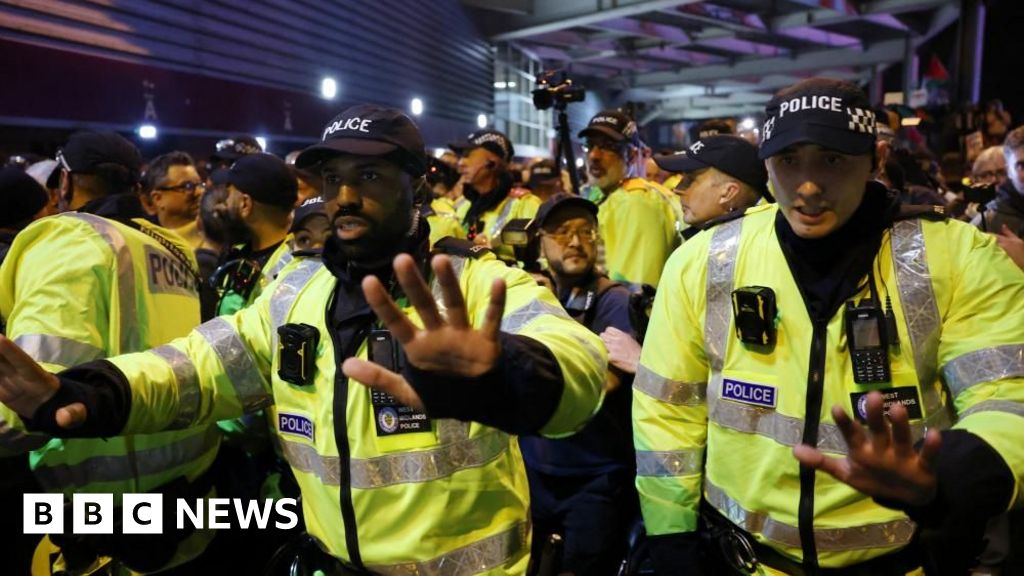

Hundreds of demonstrators gathered in Birmingham ahead of Aston Villa’s Europa League match against Maccabi Tel Aviv, prompting a large police operation and 11 arrests. West Midlands Police said more than 700 officers, supplemented by reinforcements from about 10 other forces, were deployed to manage a series of protests and counter-protests outside Villa Park.
Chief Superintendent Tom Joyce said the scale of policing reflected “unprecedented” interest and concern around the fixture, with officers preparing for the possibility that people might turn up looking for a fight. He also cited what he described as significant levels of hooliganism among the Maccabi fan base as a factor behind the decision to ban away supporters from attending the game.
Pro‑Palestinian groups assembled outside the ground waving flags and placards calling for an end to the violence in Gaza. A smaller counter‑protest by pro‑Israel campaigners marched nearby, and several flatbed vehicles carrying electronic billboards drove past the stadium before kick‑off displaying messages such as “Ban hatred not fans” alongside a quote attributed to Thierry Henry about football bringing people together.
Police used Section 60 stop‑and‑search powers across a wide area from Aston and Perry Barr through Birmingham New Street to the city centre. The powers were in force from 12:00 on Thursday until 03:00 on Friday, officers said.
Among the 11 people arrested were five on suspicion of racially aggravated public order offences. Police gave further details, saying a 34‑year‑old and a 29‑year‑old were detained over abuse directed at pro‑Israel demonstrators, while a 32‑year‑old was arrested for abuse aimed at a pro‑Palestine group. A 63‑year‑old man was held after a road‑rage incident in which racist language was alleged, and a 67‑year‑old was arrested for racist abuse of a police officer. Other arrests related to suspected drug offences and breach of the peace. A 17‑year‑old boy was detained for failing to comply with a dispersal order, and a 21‑year‑old was arrested for refusing to remove a face covering. Police also said a 21‑year‑old was held after allegedly attempting to throw fireworks into the ground. Minor scuffles were reported as fans made their way into the stadium ahead of the 20:00 GMT kick‑off.
The heavy visible policing prompted some disruption in the local area; shops and schools near Villa Park closed early on match day. Many residents and fans expressed mixed feelings about the match going ahead. Adam Selway, a Villa supporter who attended wearing a half‑and‑half scarf in the colours of Aston Villa and Maccabi Tel Aviv, said he sympathised with supporters who could not travel but stressed he was there simply to watch football, not to make a political point. “It’s not about politics, it’s about football,” he said.
Jewish Villa fan Elliot Ludvig told the BBC he felt apprehensive about attending because of the potential for violence and other unpleasant encounters for himself and his son. Fan group Punjabi Villans urged calm on social media, calling on people to respect each other and to get home safely, saying “We’re in this together. Football unites us.”
Organised calls to cancel the match had been made by groups including the Palestine Solidarity Campaign, Stop the War Coalition, the Muslim Association of Britain, Friends of Al‑Aqsa and others. Local independent MP Ayoub Khan, who opposed the fixture, attended a demonstration and led chants of “Free, Free Palestine,” saying the community had come out to support the plight of Palestinians while rejecting hooliganism and violence.
The match and the protests took place amid wider controversy: in September a UN commission of inquiry concluded there were reasonable grounds to believe Israel had committed acts amounting to genocide in Gaza, a finding that Israel’s foreign ministry rejected as distorted and false.
Maccabi Tel Aviv’s chief executive said it was “incredibly sad” that his club’s supporters could not be present and argued politics should not be dragged into football. Police and organisers said they would review the operation after the event, but the scale of the deployment and the arrests underlined the tensions that surrounded a fixture many feared would attract confrontation.