
The College Football Playoff committee released its first top-25 of the season, and as always that kick-off ranking feels like midnight Black Friday: drama, elbowing and inevitable outrage. The committee has hinted it will lean more on a new “record strength” metric to inject some math into subjective judgment, but ten weeks into a chaotic season there are still so many loose threads that fans and teams alike are holding their breath — and their pitchforks.
A few high-level facts that complicate the early list: only eight teams have beaten more than one of the committee’s current top-25, and several ranked teams are a combined 0-12 against others in that same group. The ACC’s highest team sits outside the top dozen, and no Group of 5 programs made the cut. So while the top-12 playoff chase is the headline, the committee’s early list is already shaping a narrative that will inflame plenty of schools.
Here are the programs already justified — or at least resonating — in their anger.
1) BYU (8-0, No. 7)
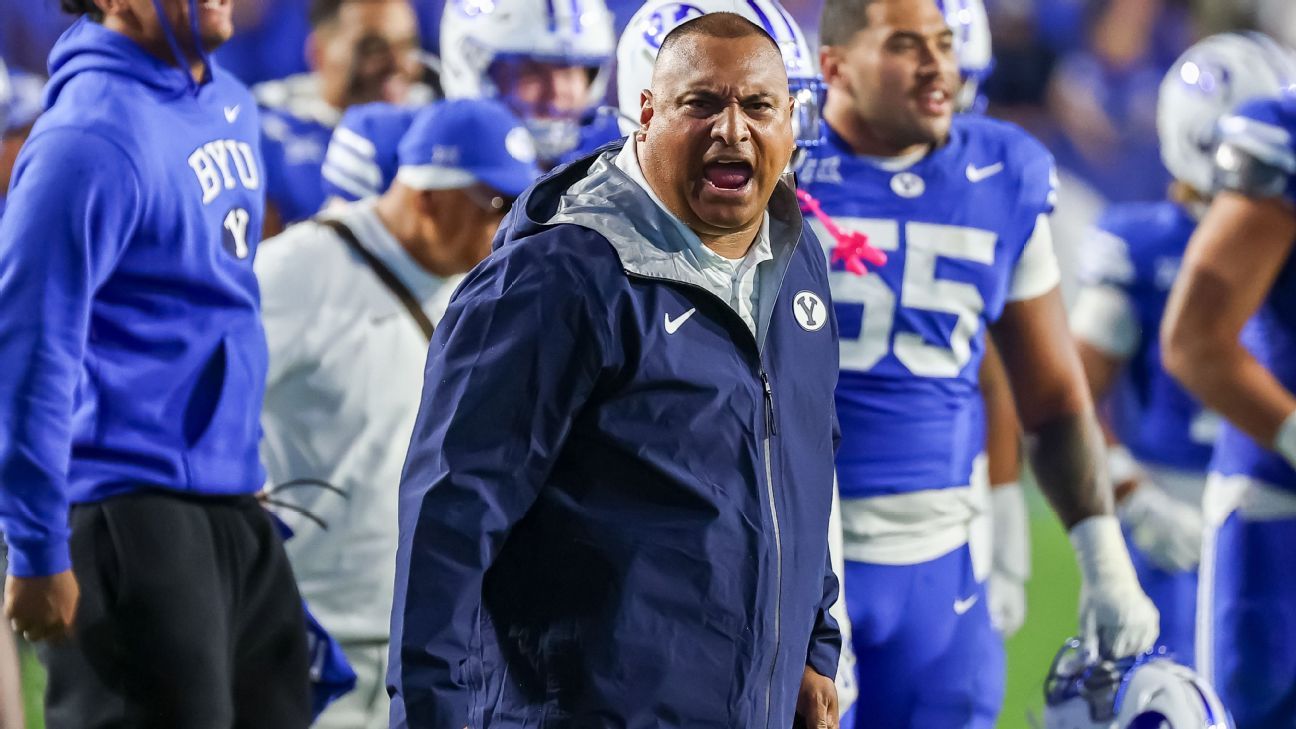
BYU’s gripe: last season’s committee left the Cougars behind several teams with inferior resumes, and the start of 2024 hasn’t felt like redemption. Compare two anonymous resumes and BYU’s looks very similar to the committee’s No. 1 team in several key metrics: close strength of record, similar strength of schedule, comparable wins against strong opponents and a best win in the low-teens of the committee poll. Yet BYU sits behind three SEC teams with at least one loss — teams whose strength-of-record measures aren’t even as good as BYU’s.
If the committee was considering compassion for BYU after last year’s snub, the ranking doesn’t show it. With a big game coming against Texas Tech, perhaps the committee deferred a hard call, but that reads more like punt than praise — and given perceived conference favoritism in past lists, the Cougars have reason to be steamed.
2) Louisville (7-1, No. 15)
Louisville feels punished by association: the ACC’s mess has dragged perceptions down and the Cardinals landed well outside where their body of work might suggest. Again, two blind resumes make the point: one profile shows more wins versus top-40 opponents, a better loss and stronger head-to-head context; the other has fewer marquee wins and a loss to an unranked team. The committee placed the team with fewer quality wins seven spots higher.
Louisville’s one loss came in double overtime in a game where it outgained the opponent by 150 yards. That usually matters. This week, it didn’t — and it’s easy to see why the Cardinals consider that a raw deal.
3) Miami (6-2, No. 18)
Miami’s drop feels rooted in narrative more than resume. The committee insists timing of losses shouldn’t matter and it shouldn’t second-guess future outcomes, yet Miami was pushed well behind another two-loss team it beat head-to-head. The Canes have multiple wins over FPI top-35 teams and quality nonconference victories, and at various points were mere turnovers away from an undefeated record.
Instead Miami’s late-season stumbles and offensive uncertainty seem to have impacted perception. If the committee is already treating recent form as predictive, Miami has fair cause to be annoyed — especially since their résumé stacks up favorably on paper.
4) The Group of 5
No Group of 5 team cracked the initial top-25, and while this season’s G5 leaders probably don’t have as compelling a case as last year’s Boise State did, the complete omission still stings. The committee indicated it’s weighing “record strength” and will penalize truly bad losses — but the practical application looks inconsistent. Memphis is the early favorite for the G5 spot despite a bad home loss to UAB and a midseason coaching change. Compare other G5 teams’ single losses: North Texas lost to an opponent mostly inside the top-30 of SP+, James Madison’s lone loss came to a top-20 SP+ team, San Diego State lost to a lower-ranked SP+ opponent — but Memphis’s loss came to a team ranked around 119 in SP+.
If the committee isn’t counting that kind of bad loss, Group of 5 programs have reason to complain that the new guidance isn’t being applied evenly.
5) The SEC versus the Big Ten narrative
The back half of the top 25 often doubles as a regional shoutout. This year, the committee crammed several Big Ten teams into the lower ranks — teams from a conference that has uneven quality and still contains squads with zero conference wins — while many SEC teams with tough, one-possession conference slates sit scattered in ways that don’t always seem to reflect the SEC’s depth.
One of the committee’s preferred metrics is wins over ranked opponents, which can be gamed by conference composition. Placing certain Big Ten teams ahead of SEC opponents lifts the résumés of teams that haven’t beaten anyone particularly noteworthy, and that discrepancy fuels SEC grumbling. In short: perceived conference favoritism, whether intended or accidental, will make a lot of fans and programs mad.
Also angry (short list): Virginia (8-1, No. 14) — notably behind several two-loss teams despite a superior record; USF (6-2), Arizona State (6-3) and Cincinnati (7-2) — all unranked despite credentials that warrant at least conversation; and, of course, coaches and fanbases across the sport who feel the committee hasn’t applied its stated metrics consistently.
Bottom line: the initial CFP rankings are the opening salvo. There’s still a month of football and a lot of reordering ahead, but the committee’s early choices — perceived inconsistencies in applying new metrics, conference placement and head-to-head interpretations — have already produced a long list of valid grievances. The anger is more simmer than boil right now, but give it a few weekends: it won’t stay polite for long.