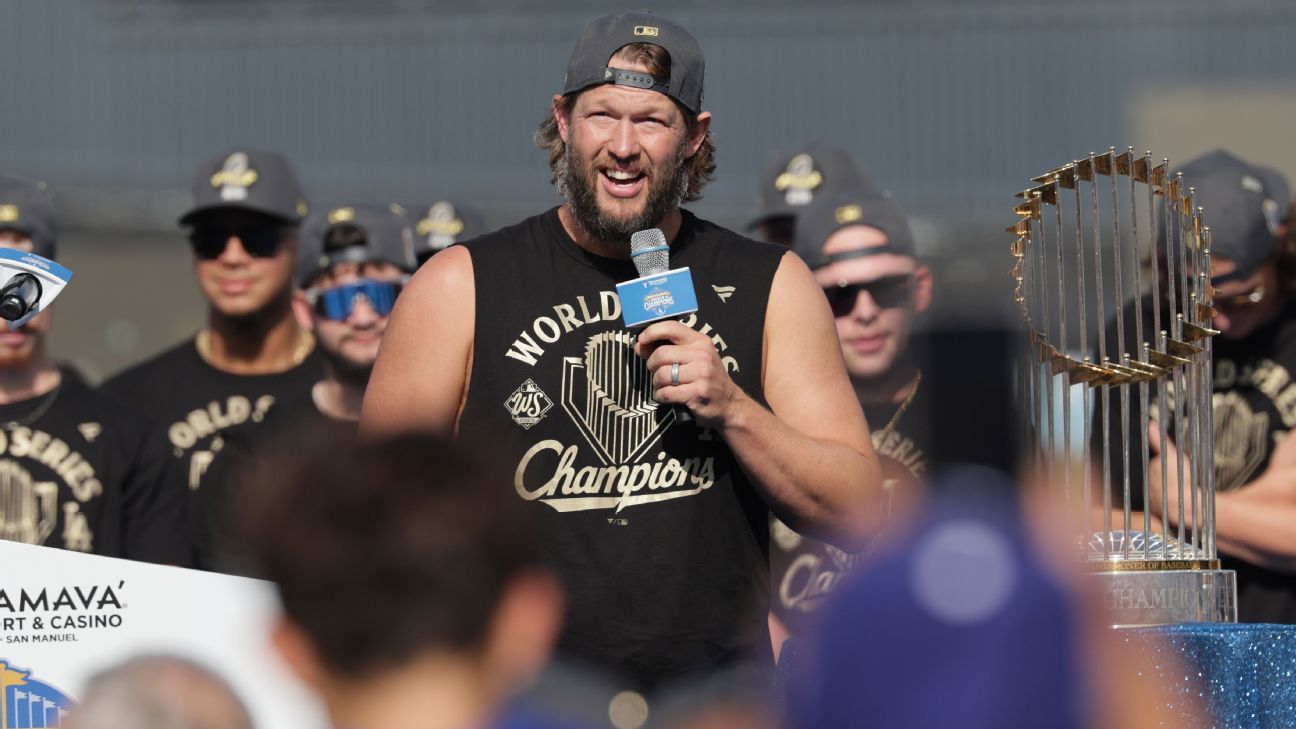

The final strains of “We Are Young” boomed through Dodger Stadium as Clayton Kershaw walked out one last time, sleeves already cut off his championship T-shirt and emotion barely contained. Surrounded by 52,703 fans at the World Series parade, he struggled for words and wound up simply saying “thank you” again and again — a fitting coda to an 18-year career that became indistinguishable from the identity of the franchise he carried for decades.
Kershaw’s farewell season was a sequence of fitting milestones: a 3,000th strikeout on July 3, a standing ovation in his final home start on Sept. 19 and, ultimately, his third World Series ring in six years on Nov. 2. He announced his retirement late in the season, telling teammates and fans he would remain a Dodger for life. That bond — to the team, the city and the clubhouse — is central to how he’ll be remembered.
Statistically, Kershaw’s prime was transcendent. From 2009–17 he won 139 regular-season games with a 2.25 ERA across 1,827 1/3 innings, earning three Cy Young Awards, an MVP and accumulating roughly 56.5 wins above replacement by FanGraphs — numbers that place him among the game’s elite. But his legacy runs deeper than peak metrics. It was shaped equally by persistence: adapting when velocity slipped, battling recurring injuries and finding ways to contribute even as the game around him became younger and faster.
Between 2020 and 2025 Kershaw fought through back, elbow, forearm, shoulder and toe problems. His four-seam average fell well below league norms — roughly 88.9 mph in a season when MLB average velocity kept climbing — yet his overall performance remained elite, posting a 2.90 ERA over that span, one of the very best marks among workhorse pitchers.
That ability to win without overpowering stuff drew admiration from peers. Max Scherzer noted that Kershaw’s craftfulness undermined simple analytic models: he showed that location, sequencing and command still matter even when metrics favor velocity. Younger Dodgers credited him with changing how they approached preparation and recovery. Blake Snell said Kershaw simply “pitched a lot of innings for us that we really needed” — a blunt acknowledgement that veteran steadiness helped stabilize a rotation beset by injuries to other arms.
Kershaw’s season was less about gaudy velocity and more about timing, guile and experience. He made 22 starts with an 11–2 record and a 3.39 ERA, and August featured a remarkable run in which he allowed just one home run and three walks over 28 2/3 innings. Managers and teammates repeatedly pointed to his routine, consistency and attention to detail as contagious forces in the clubhouse.
As the Dodgers’ younger starters returned to form down the stretch — and with the postseason rotation set around Snell, Yamamoto, Glasnow and Shohei Ohtani — Kershaw accepted a diminished traditional role and reinvented himself for the playoffs. He spent the final month of his career learning how to pitch in relief: asking questions, experimenting with shorter warmups and embracing a support role. Even when deployed sparingly, he provided valuable innings, protecting fresher arms and helping the team navigate a bruising postseason.
His postseason contributions included a short but pivotal relief appearance that helped preserve bullpen resources in the Division Series and one of the most dramatic outs of the World Series. In a late inning of a marathon World Series game, Kershaw warmed up multiple times in the bullpen and then delivered: mixing a slider at nearly 90 mph with a 91.9 mph fastball and retiring a batter to keep the game tied. That outing turned out to be both his last appearance in Dodger Stadium and his final pitch as a major leaguer.
Beyond on-field results, Kershaw’s influence on teammates — established stars and rookies alike — may be the most durable part of his legacy. He bridged eras in Los Angeles, arriving when the franchise was still trying to find its footing, enduring ownership turmoil and then helping seed the culture that produced sustained excellence. Teammates say he modeled daily preparation rather than grand gestures: arriving early, staying disciplined, focusing on fundamentals and offering quiet, consistent support. Tyler Glasnow called him “the most selfless pitcher” and described how Kershaw’s approach helped Glasnow move past rough outings. Young pitchers like Emmet Sheehan, Jack Dreyer and Justin Wrobleski cited watching and imitating Kershaw’s routines as formative.
Dodgers pitching coach Mark Prior and executive leadership noticed how that example accelerated the development of a staff that skewed younger and more analytic. Walker Buehler’s data-driven approach had exposed Kershaw to new ways of pitching; Kershaw, in turn, combined that learning with old-school preparation and passed it forward.
Kershaw’s stature also extended beyond the mound. Magic Johnson compared his impact on the franchise and the community to that of Kobe Bryant — a measure of the cultural footprint he left in Los Angeles. Team president Andrew Friedman made a symbolic offer during the World Series celebration to keep Kershaw close to the organization; Kershaw demurred about coaching, preferring to focus on family, though he expressed a curiosity about broader questions in the sport, particularly how to keep pitchers healthy as throwing velocity climbs across baseball.
When asked about retirement, Kershaw said leaving now felt right: he wanted to step away while he could still be proud of his work and while the team was at its peak. He acknowledged that staying with a championship-caliber club — even if it meant giving up a postseason starting role — brought him peace. “I’m a champion for life,” he said, and meant it literally and figuratively.
As the Dodgers look to sustain their excellence, Kershaw’s imprint will remain: as the competitive standard younger pitchers measured themselves against, as a teacher whose habits and humility shaped clubhouse norms, and as the link between eras — the anchor who helped turn a once-frustrating franchise into a modern dynasty. He leaves not only a Hall of Fame résumé, but a template for longevity: technique over heat, preparation over flash, and generosity of spirit that may well define the next generation of Dodgers.