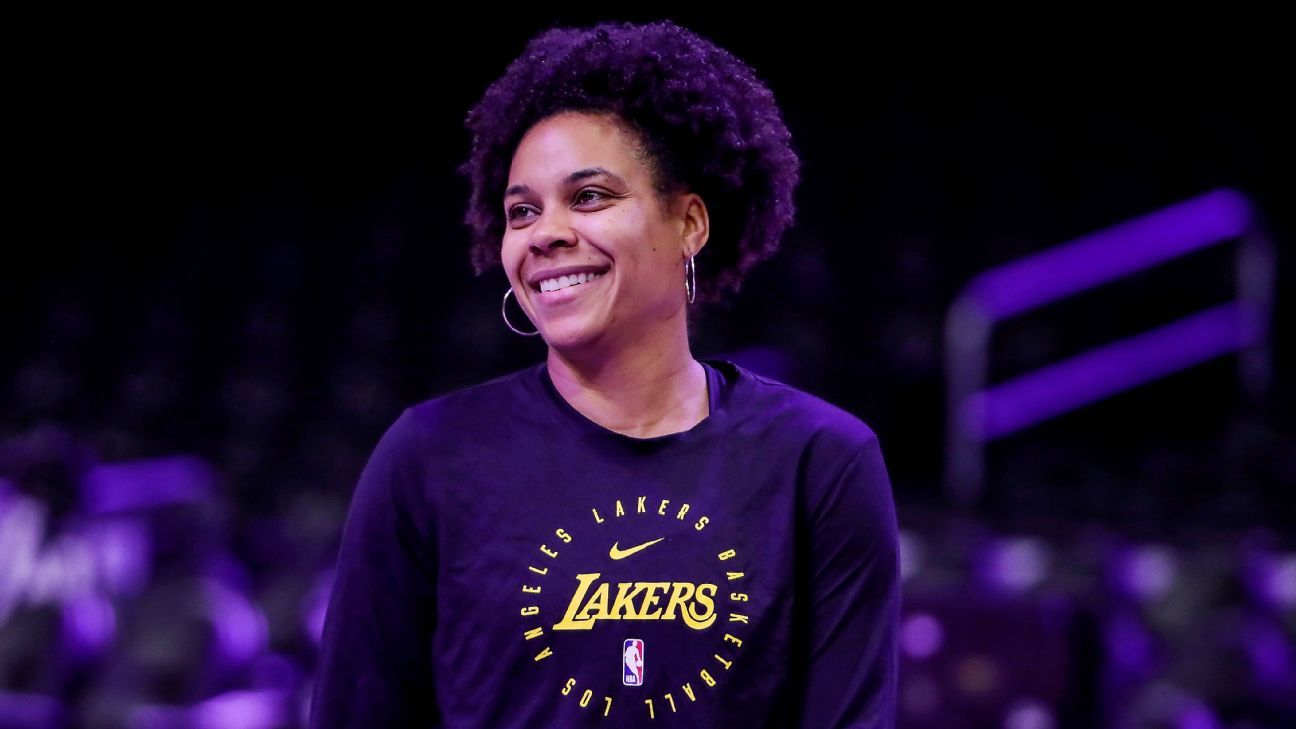

When Lindsey Harding saw Stockton Kings assistant GM Gabriel Harris walking toward the practice court on Dec. 15, 2023, she assumed he was delivering the sort of news coaches pray for — an NBA 10-day call-up for a player. Harding, in her first season as the G League’s first Black woman head coach, had learned to keep her phone loud so she wouldn’t miss life-changing opportunities amid the noise of practice.
Instead, Harris told her law enforcement officers were there to arrest center Chance Comanche. The shock was immediate and total. Four days later Comanche was extradited to Las Vegas and charged in a case that would end with murder, kidnapping and conspiracy accusations. The horrifying details — alleged involvement in the strangulation death of a 23-year-old woman — left Harding’s team reeling.
She found herself managing more than rotations and practice plans. The Kings were in the middle of a road trip when the arrest happened: a bus ride to Santa Cruz for a game, then a flight to Orlando for the G League Winter Showcase. Players and opponents peppered Stockton with questions Harding could not answer. She organized crisis support with the NBA and the Kings’ parent club, tried to postpone games, and even took her team to an amusement park to get them out of a hotel that felt like a fishbowl. “I didn’t want to be in the hotel because everyone knows we’re Stockton,” she said later. “They look at you.”
Against that fog, Harding kept the team focused. Stockton managed a strong recovery, finishing the regular season 24-10, and Harding was voted G League Coach of the Year — the first woman to receive the honor. The season, as traumatic as parts of it were, became a crucible that sharpened her leadership.
Nearly two years later, Harding is an assistant coach with the Los Angeles Lakers — the first woman to hold that role in franchise history. The path to L.A. traces back to an elite playing career and a string of front-office and development roles that made her a natural candidate for coaching at the highest level.
At Duke, Harding was the women’s Naismith College Player of the Year and the No. 1 pick in the 2007 WNBA draft. She played nine seasons in the WNBA and spent time overseas before retiring in 2017. Rather than stepping away from basketball, she enrolled in the NBA’s Basketball Operations Associates Program, a development pipeline that opened doors in personnel and player development. A connection made there led to a scouting and player-development role with the Philadelphia 76ers — she became the first woman in Sixers history to serve as a pro-personnel scout.
Her longstanding friendship with JJ Redick, who lived in the same dorm as her at Duke and is now the Lakers’ head coach, helped smooth her transition to L.A., but it was her résumé and presence that earned the job. Lakers president of basketball operations Rob Pelinka and acting governor Jeanie Buss had both come to know Harding earlier in her career, and both supported her addition to the staff. “She’s a professional, she knows the game, she is a great communicator,” Buss said, praising Harding’s energy and positivity.
Harding’s duties with the Lakers are broad. She splits scouting report responsibilities with other assistants, preparing reports for about a third of the team’s games. She runs scout team sessions to simulate opponents — teaching players how to imitate an opponent’s tendencies in practice — and she coached the Lakers’ summer league squad in Las Vegas. She also works closely with players like Gabe Vincent and rookie Adou Thiero.
Players and executives notice her approach. Vincent described her as less boisterous than some staffers, more likely to pull a player aside and work through a challenge one-on-one. “She really just does a good job at trying to help her players,” he said. Peers and front-office figures call her someone who builds relationships, communicates clearly and tells the truth — qualities former coaches and executives say are essential for a head coach.
Harding’s interactions with stars illustrate both her humility and her ambition. In a tense moment late in a season, LeBron James turned to her on the bench and asked, “So you want to be a head coach, right?” He offered simple in-game advice — slow it down, post someone up — and Harding filed it away. She has head-coaching experience beyond the G League, too: she coached the Mexico and South Sudan women’s national teams and has been pursued for WNBA openings.
Ambition is clear. Harding wants to be an NBA head coach and she is methodically building the resume to make that possible. She’s open to WNBA head coaching opportunities if they make sense, but she’s not rushing. “I am in an amazing position right now,” she said. “I want to be a head coach. I know I will be a head coach, and I don’t feel a rush at that because I’m still learning every single day.”
Not everyone is convinced that an NBA team will hire a woman head coach soon; Dawn Staley recently expressed skepticism. Harding pushes back on the notion that gender should be the disqualifier. “Why is it a challenge? Because a woman’s never done it?” she asked. “Why is that an issue? … I can do what 29 other coaches do every year and not win a championship. But yet you keep recycling the same type of people. Is that a risk or not? So why is this a risk?”
Executives who have worked with her are emphatic about her readiness. Trajan Langdon, a president of basketball operations, praised her communication and relationship-building. Mike Brown said she has the presence and honesty needed to connect a locker room. Redick admires her no-nonsense coaching and her subtle, effective one-on-one interactions.
Throughout, Harding points to the hard season in Stockton as proof of her capacity. The trauma of Comanche’s arrest and the responsibility of shepherding a shaken roster through a public spectacle were unlike anything a coach typically faces, and she says the experience hardened her confidence.
“I can deal with anything,” Harding said. That conviction underpins her next moves: learning from veterans in L.A., continuing to accumulate experience and waiting for — or creating — the right opening to become the next woman to break another barrier in professional basketball.