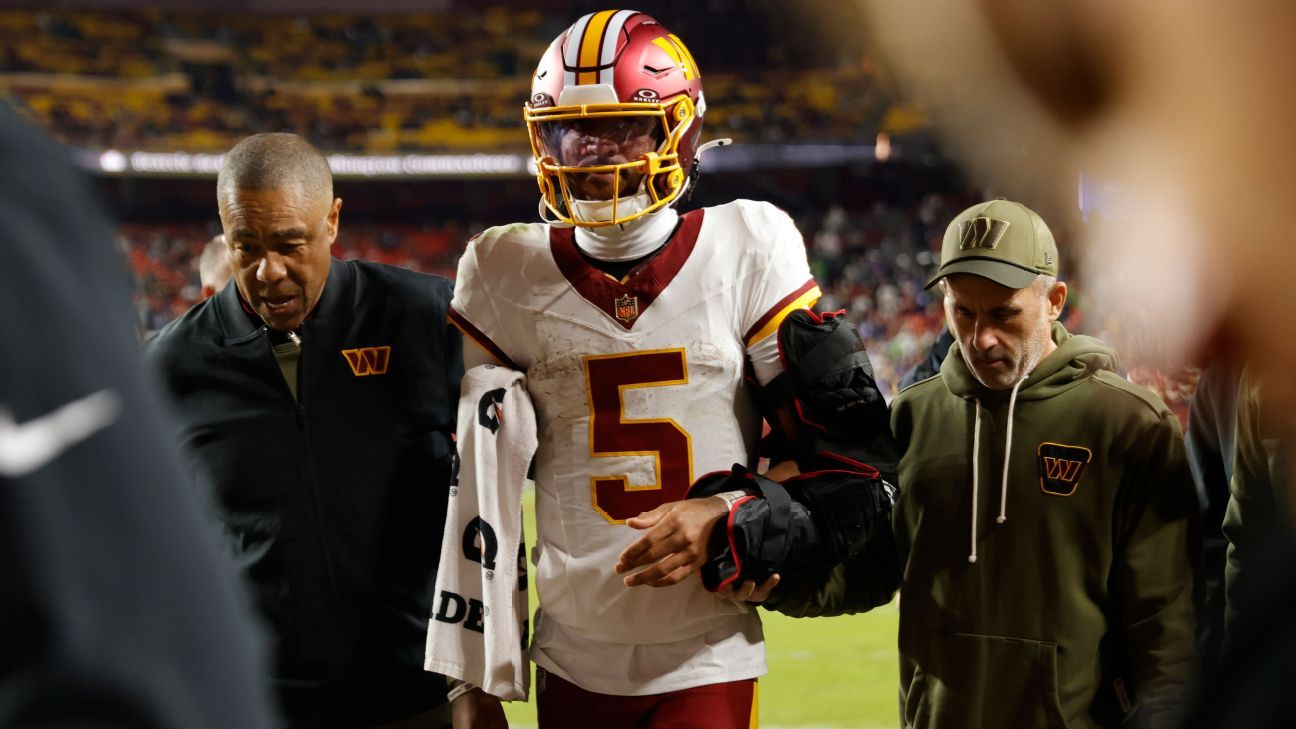

Washington’s latest quarterback setback — Jayden Daniels leaving Sunday’s blowout late with a dislocated elbow — felt painfully familiar to long-suffering Commanders fans. It wasn’t just about one injury; it was a reminder of how franchise decisions around protecting a young signal-caller can shape careers and seasons.
A decade-plus ago, Robert Griffin III arrived as a savior of sorts: a Heisman winner who won Offensive Rookie of the Year and seemed to have the makings of a long-term star. In that 2012 wild-card game against the Seahawks, Griffin clearly aggravated a knee injury in the first quarter. Coach Mike Shanahan elected to keep him in rather than turn to backup Kirk Cousins. The offense stalled, Griffin’s knee hyperextended on a low snap, he had surgery days later, and he never regained the trajectory he had before that injury. Griffin threw 27 touchdowns before that injury and, remarkably, finished his career with 26 after it.
The specifics of Daniels’ elbow injury, and its expected severity, differ from Griffin’s torn knee ligaments. Daniels’ dislocation involved his non-throwing arm; RGIII’s injury destroyed a lower body that defined his mobility and value. Yet to many fans the image is similar: a dynamic young talent left exposed late in a lopsided game when preservation should have been paramount.
Questions about why Daniels remained on the field mounted quickly. He had been hampered by a hamstring problem that limited his mobility, and he had been forced to absorb more contact than a rising franchise quarterback should. Footage of the play showed him scrambling with what appeared to be a blown blocking assignment. Why keep a starter in a finish that had long been decided, especially when the player was already compromised? If the coaching staff wanted him there for continuity, why not limit his snaps to low-risk plays?
Coach Dan Quinn acknowledged the mistake publicly this week, saying he’d been thinking about the decision “nonstop” and admitted he’d missed the right call. That candor helps, but the ramifications are significant. Quinn said Daniels will be out “a while,” a dire prospect for a 3-6 team that was hoping to build around its young quarterback.
There is an element of football’s unavoidable brutality here. The sport is physical, and even the most cautious teams can’t eliminate the risk of injury. Players sometimes tell medical staff they’re fine when they’re not, and coaches weigh competitive instincts against preservation. Yet protecting a franchise QB isn’t about making the game soft; it’s about valuing a player whose health directly affects a franchise’s future. The rules and culture around the NFL already favor keeping quarterbacks protected for that reason.
Daniels’ workload and physical toll have been noteworthy. He has been sacked 17 times in the six games he has played this season, and he has been one of the most-hit quarterbacks in the league — recording 322 hits over the past two seasons, the most in the NFL in that span. At 6-foot-4 and about 210 pounds, Daniels isn’t a running back-style battering ram; he relies on mobility and clean pockets. Repeated exposure to heavy contact threatens both short-term availability and long-term development.
Part of the problem is structural: Washington has not consistently built an offensive line capable of keeping him clean. That reality, coupled with choices about when to take a starter out of a game in which the outcome is already decided, compounds the risk.
The franchise’s history adds weight to the decision-making calculus. After failing to protect Griffin and watching his career derail, Washington spent years searching for another quarterback. Last season, another rookie Heisman winner guided the team to the NFC Championship, reinforcing how vital a protected, healthy quarterback is to franchise success. Now, with Daniels sidelined, the organization must re-examine how it manages its most important asset.
Quinn has promised comprehensive support for Daniels — medical care, coaching adjustments and organizational attention — and vowed to “get that part right.” That will need to include honest evaluations of play-calling in garbage time, stricter limits on exposing the QB when the score is decided, and a serious look at personnel and scheme to reduce the hits he takes.
The label “franchise quarterback” carries two obligations: the player must perform like one, and the organization must do everything practical to keep him available. Washington’s recent history shows how costly it can be when the second half of that bargain is overlooked. The hope now is that Daniels recovers fully and that the Commanders learn the hard lesson again — this time early enough to protect their investment and their future.