
Last year women’s college basketball began amid major upheaval: conference realignment reshaped rivalries, the Pac-12 collapsed, and the quad system was being phased in. This offseason was much quieter, but with the 2025–26 campaign now underway, every game from here on matters for NCAA tournament positioning. Bracketology will track those shifts all season, with weekly updates starting Tuesday and twice-weekly 68-team projections beginning in January and continuing through Selection Sunday on March 15.
Before the schedule piles up, here are five questions that will have the biggest impact on how the 2026 bracket forms.
1) How will the Big Ten perform in nonconference play?
Preseason Bracketology had as many as 13 Big Ten teams projected to make the NCAA tournament — a number that would break the conference’s record of 12 from last season. But several of those projected bids belong to teams seeded 9 or lower, including programs such as Nebraska, Oregon, Illinois and Minnesota, which means 13 is far from guaranteed.
Because the league is so deep, many teams will cannibalize each other once conference play starts. To convert depth into actual bids, Big Ten teams must build résumés in November and December. Good nonconference wins boost individual profiles and improve NET and strength-of-schedule metrics across the league. Victories over top opponents — for example, a Michigan win over Notre Dame or UConn — would elevate that team and make future conference wins look even better. How Big Ten squads perform before the league slate begins will largely determine whether the conference truly dominates the tournament field.
2) Who will replace Chloe Kitts’ production for South Carolina?
South Carolina’s season-opening loss of Chloe Kitts to a knee injury creates a big frontcourt hole. Coach Dawn Staley has shifted toward a three-guard look in exhibitions with Ta’Niya Latson, Tessa Johnson and Raven Johnson starting while 6-foot-3 sophomore Joyce Edwards and 6-foot-6 transfer Madina Okot provide size. That lineup still projects as a Final Four contender because of perimeter firepower and veteran coaching.
The key question is depth inside. The returning frontcourt reserves — Maryam Dauda and Adhel Tac — combined for very limited minutes a season ago. If Staley can expand roles for Edwards, Dauda or Tac, or if Okot becomes a consistent interior force, the Gamecocks can maintain their No. 1-seed trajectory. If not, South Carolina could be more guard-oriented than the dominant inside teams it has been in recent years. Latson’s scoring and Edwards’ potential are encouraging, but replacing Kitts’ 10.2 points and 7.7 rebounds per game is central to whether the Gamecocks remain a top seed in March.
3) What will USC look like without JuJu Watkins?
USC lost JuJu Watkins for the season to a knee injury from the 2025 tournament and returns almost none of last year’s rotation — six of the seven rotation players from a season ago won’t suit up this year. Kennedy Smith is the only returner who averaged more than 13 minutes, so this is effectively a rebuilt roster.
Talent is still present: transfers Kara Dunn and Londynn Jones and freshman Jazzy Davidson headline a collection of new faces that could be transformative. But with so many unknowns, USC is the most unpredictable team in the AP Top 25. The Trojans could either rise to challenge conference favorites and contend for a high seed, or they could struggle through a tough nonconference slate and Big Ten gauntlet and find themselves nearer the bubble than the bracket hosts. How quickly the newcomers gel will determine where USC lands come Selection Sunday.
4) How will the SEC race shape the top seed lines?
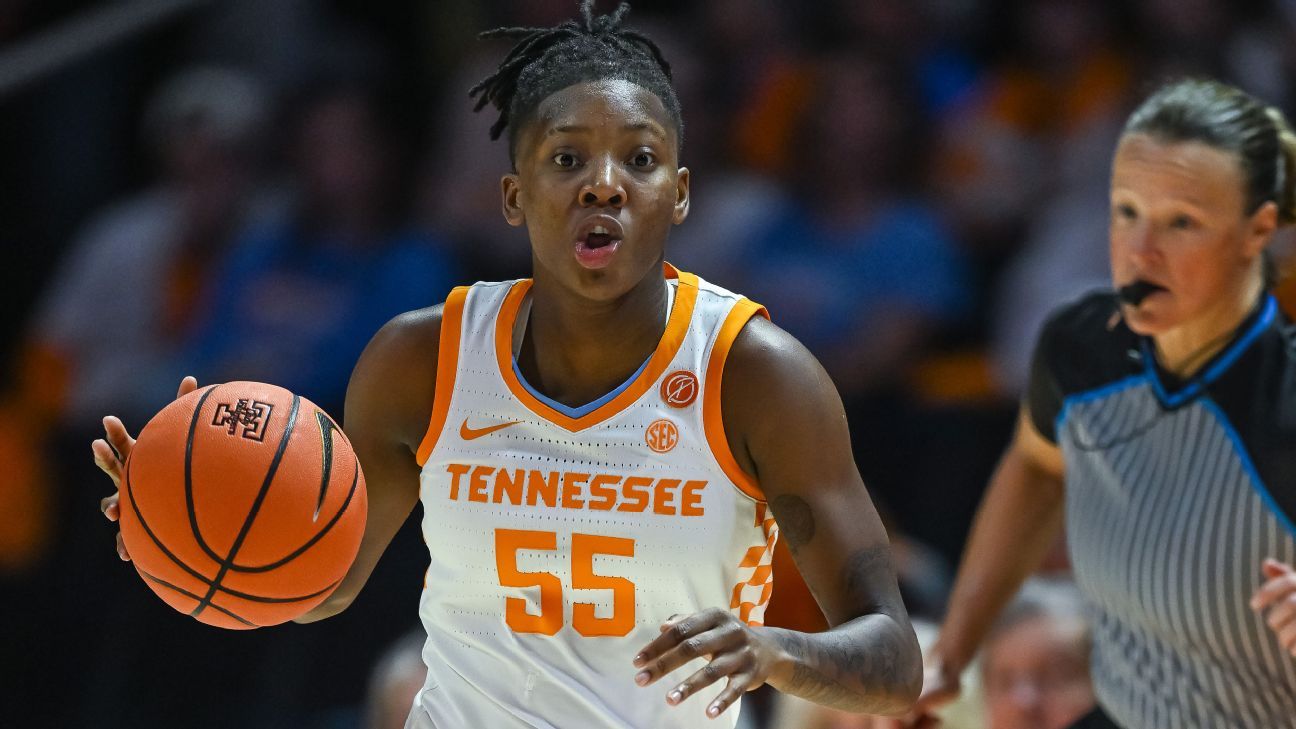
No conference has as much top-end talent as the SEC. Preseason projections put five SEC teams on the top two seed lines, and South Carolina and Texas were pegged as No. 1 seeds. Oklahoma and Tennessee were projected as No. 2 seeds, meaning the SEC’s internal pecking order will go a long way toward shaping which programs occupy the No. 1 and No. 2 seed lines nationally.
Key head-to-heads will matter: South Carolina at Oklahoma (Jan. 22) and Tennessee hosting Texas (Feb. 15) are prime examples. Upsets in those marquee SEC matchups would tighten the standings and could push programs like Oklahoma or Tennessee into legitimate top-two seed conversations, while also influencing how many SEC teams receive top-four protections. In short, the SEC regular-season race may determine not only conference seeding but the architecture of the whole bracket.
5) Which mid-majors will emerge as at-large candidates?
Beyond the power conferences, several mid-majors could fight for at-large berths. In the Ivy League, Princeton and Columbia are positioned to claim at-large consideration if they finish 1–2 in league play and meet in the conference final. The Missouri Valley also has potential for multiple bids: Murray State and Belmont could push the MVC to two NCAA teams again if Belmont picks up a marquee nonconference win and Murray State wins the conference tournament.
Belmont’s nonconference slate — which includes games against Tennessee, Kentucky, Princeton and Duke — is a proving ground; even one quality win would help its at-large case. In the Atlantic 10, Richmond is the favorite, but George Mason looks capable of threatening for the league crown and a possible at-large profile.
Bottom line
The next two months of nonconference play will clarify a lot of these storylines. Big Ten depth will be tested before league play shrinks résumés; South Carolina needs interior production to replace Kitts; USC’s rebuild hinges on how quickly new pieces perform; the SEC’s internal outcomes will influence the top seed lines; and several mid-majors have opportunities to build at-large résumés with strong nonconference results. Expect bracket projections to evolve rapidly as these questions find answers between now and Selection Sunday on March 15.