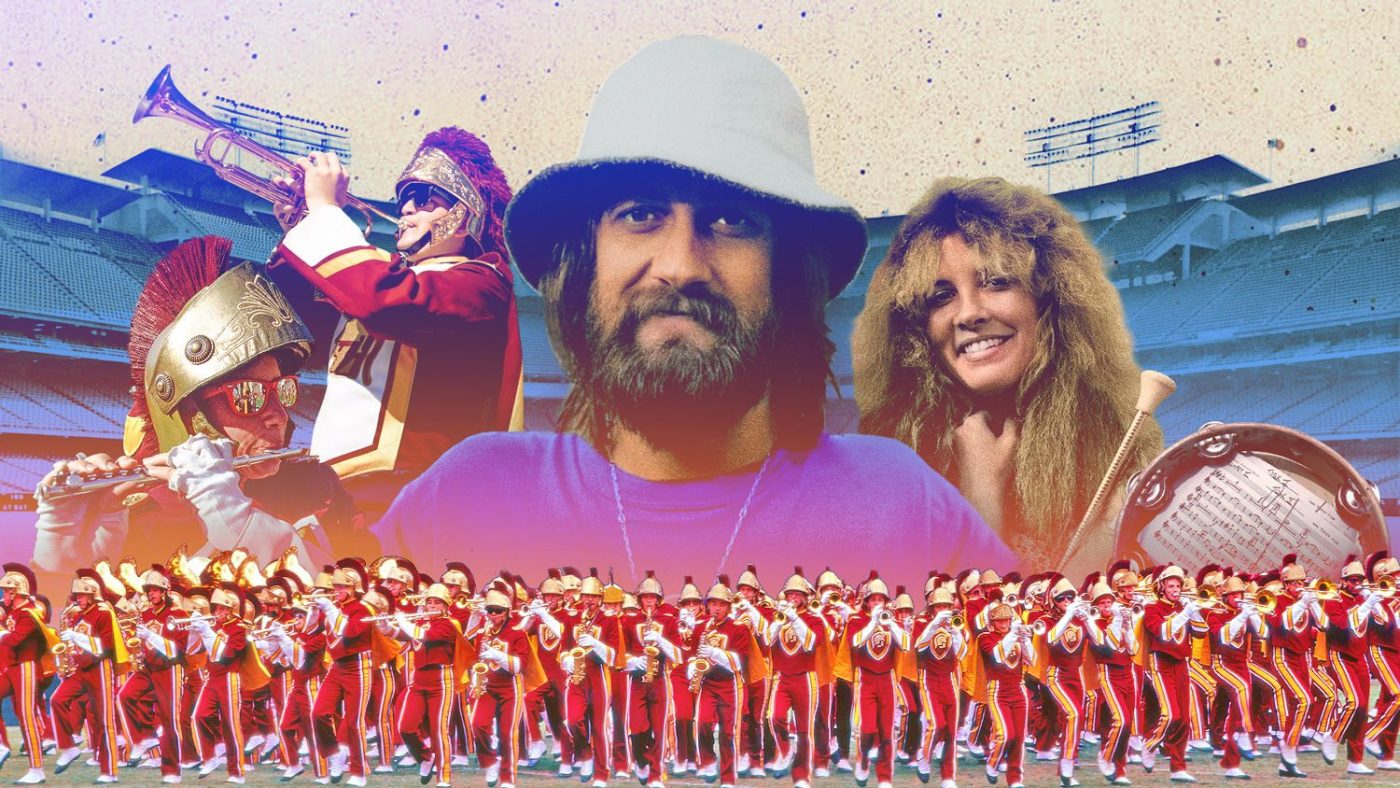

On a recent Friday at the Los Angeles Memorial Coliseum, retired USC band director Dr. Arthur C. Bartner, 85, scanned the 50-yard line until he spotted an old collaborator: Mick Fleetwood, 79. They embraced, and Bartner later said Fleetwood’s expression showed a deep appreciation for their long friendship. “You made my career,” Bartner told him. Fleetwood then joined the Trojan Marching Band to play “Tusk” once more — 46 years after the original session that linked a wildly popular rock band with a college marching band.
The story began in 1979, after the runaway success of Rumours. With a then-extraordinary $1 million budget for their follow-up, Fleetwood Mac was exploring new directions. Mick Fleetwood, inspired by a brass parade he saw while sleepless in Barfleur, Normandy, imagined a marching band answering a driving guitar riff Lindsey Buckingham had been playing. He phoned USC’s band offices and, after confirmation from assistant director Tony Fox, arrangements began.
Bartner and Fox met Buckingham and Fleetwood at Village Recorders to sketch out parts, then worked with the Spirit of Troy to refine them. Fleetwood proposed an ambitious live recording at Dodger Stadium. The idea was expensive, but an enthusiastic Ron Cey, then the Dodgers’ third baseman, helped secure the stadium for the session.
On June 4, 1979, 112 members of the Spirit of Troy, in full uniform, recorded at Dodger Stadium. Engineers ran cables to remote trucks; Bartner conducted from a ladder while drum major Rodney Davis — USC’s first Black drum major, a three-year standout from Carson, California — held music and made last-minute cues. The session blended Fleetwood’s tribal toms, Buckingham’s riff and vocals, and the enormous brass-and-percussion sound of the marching band. The band filmed the session too; footage and close-ups of Davis’s high-stepping would later help the song’s visual identity when MTV began airing music videos.
Rehearsals resembled a movie set: students relaxed in dugouts, uniforms were spread across the outfield, and Fleetwood’s loose, freeform energy required the band leaders to find a workable consistency. To keep time across the cavernous stadium, Fleetwood even pounded the ground with his foot. Warner Bros. supplied a life-size posterboard of bassist John McVie, who was sailing to Tahiti, so the band could pretend he was there. Stevie Nicks twirled a baton she’d learned as a child and was jokingly dubbed the day’s “official twirler.”
The finished single, released three months later, combined the Dodger Stadium band with studio overdubs and eccentric touches — reportedly including Fleetwood slapping a leg of lamb with a spatula — to create a deliberately unconventional lead track that signaled the album was not a Rumours repeat. “Tusk” became the band’s biggest U.K. hit since 1973, sold more than a million copies as a single, and helped the album go platinum. At USC’s 1980 homecoming halftime, Fleetwood Mac presented Bartner with a platinum album, making the Trojan Marching Band the first college band to receive that honor.
The collaboration was notable for several reasons. Marching bands had long borrowed pop tunes, but rarely had a college band’s directors helped write or arrange a track and recorded the original with a major rock act. The Dodger Stadium shoot was also an early behind-the-scenes style music video: what sounded like free improv in the middle of the song was actually the product of careful rehearsal and the band’s discipline, which made the spontaneous-sounding section work.
The partnership didn’t end there. In December 1979 the Trojan band joined Fleetwood Mac for five Forum shows, and in 1997 they reunited for The Dance at Warner Bros. Studios. The updated “Tusk” and the show-closing “Don’t Stop” appeared on the live album, which sold more than five million copies in the U.S., earning a second platinum disc shared by the band and USC.
Under Bartner and Fox, the Spirit of Troy became known as “Hollywood’s Band,” appearing in films such as The Naked Gun and Forrest Gump and at major awards shows alongside artists like Beyoncé, Hugh Jackman, Outkast and Radiohead. Bartner conducted the All-American College Marching Band at the 1984 Los Angeles Olympics. Fox retired in 2016 after 45 years; Bartner retired in 2020 after a 50-year run.
The song’s influence extended into college football culture and beyond. USC kept “Tusk” as a pregame staple, a postgame tune and a feature at special events. Alumni bands have reunited — on one occasion 800 members returned to perform “Tusk” at Bartner’s 40th anniversary halftime — and visiting artists such as Lindsey Buckingham have since lectured at USC about the track’s experimental spirit. Other schools’ bands adapted the tune too: Alabama’s Million Dollar Band adopted it unofficially, and students added a chorus chanting “U-C-L-A SUCKS” during performances.
For those who took part, the project was less about money than about giving students a role in a historic musical experiment. Fox said the song felt like “our tune” because the Trojan band’s drumbeat became central to it. Fleetwood has remained proud of the partnership and the song’s afterlife in stadiums; he once told Bartner that whenever he hears that pulse in a crowd, he thinks, “Oh my God. They’re still playing it.”
Bartner still marvels at the song’s reach. At his granddaughter’s wedding, an 84-year-old guest told him he plays “Tusk” while washing dishes back in Oshkosh, Wisconsin. For Bartner, Fox and countless USC students — many of them non-music majors — the collaboration was about creating an unforgettable moment in music history: a rock band’s experiment that relied on a college marching band’s precision, showmanship and spirit, and in return made the band part of a lasting cultural legacy.