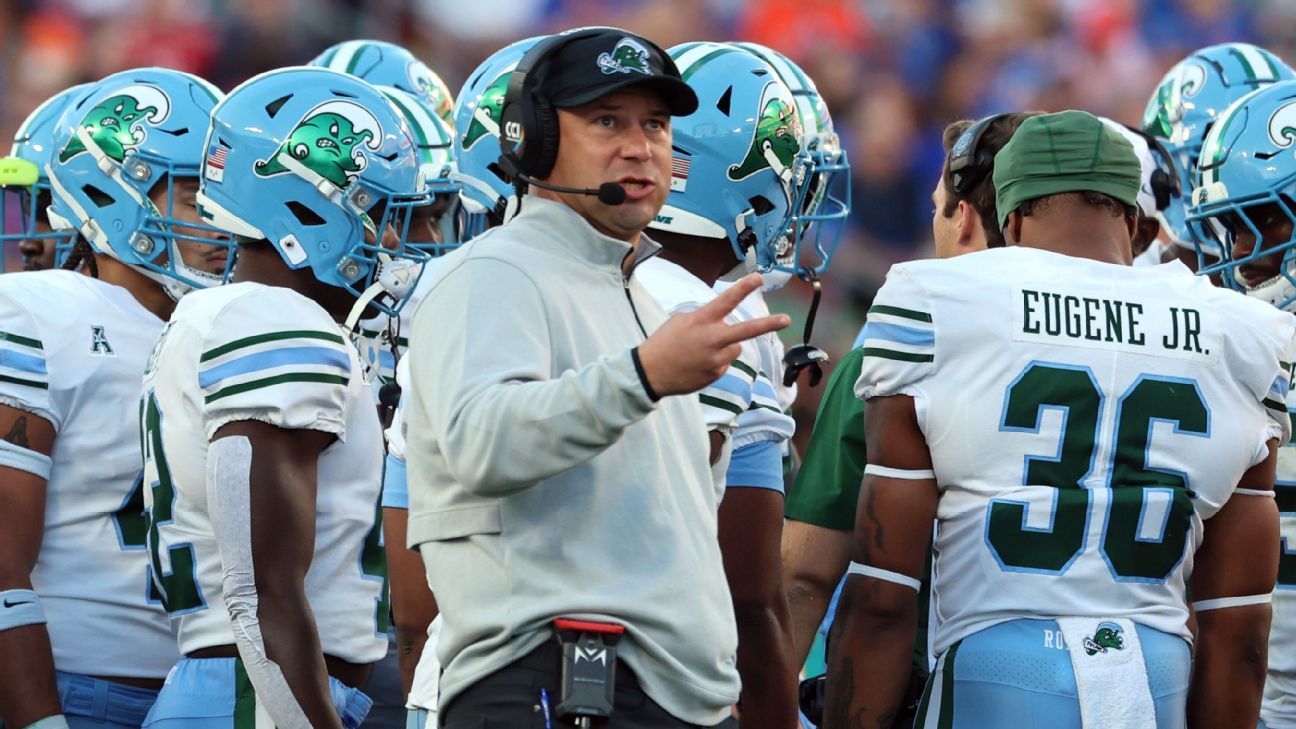

NEW ORLEANS — In July, Tulane coach Jon Sumrall organized a Wednesday speaker series for his players. The lineup ranged from Kellen Moore, then newly hired as the New Orleans Saints coach, to a financial planner and an NFL player agent. Sumrall closed the session himself — but he didn’t give a normal motivational speech. Instead he spoke plainly about the reality of the coaching business and how it mirrors the players’ world.
He asked roughly half the roster if they had agents, pointed out that he and many assistants also rely on agents to field offers, and said some staff members had declined Power Four moves to remain at Tulane for 2025. Sumrall told players he needed them to understand that the roster they saw in July might look very different by season’s end. He framed that transparency as a lesson learned: in 2024 he kept his head down during a late-season collapse and didn’t address the distractions — and that silence cost him.
After a 9-2 start in 2024, Tulane lost its final three games and saw key contributors, including quarterback Darian Mensah and running back Makhi Hughes, transfer away. Determined not to repeat that cycle, Sumrall chose to be candid up front this year, urging players to lock in and treat potential outside attention as something to be set aside until the season’s over. He demanded full focus through the conference schedule with one goal: compete for a championship.
Distractions arrived quickly. On Oct. 26, while Sumrall was delivering an intense practice message about complacency, LSU fired Brian Kelly — opening one of the nation’s premier jobs just 82 miles away. Sumrall, an SEC player and assistant in his past who had won two Sun Belt titles at Troy and compiled a 15-7 record in a season-plus at Tulane, immediately surfaced in coaching rumor lists. By Oct. 30, Tulane was taking heat on the field, suffering a 48-26 loss at UTSA that marked the most points a Sumrall team had allowed under his watch.
Still, the Green Wave remained in the American Athletic Conference title chase as they prepared to visit Memphis. And Sumrall’s name kept circulating among Southern openings — LSU clearly the crown jewel, but Auburn and even Kentucky (his alma mater) among possibilities, especially with a flurry of coaching movement across the sport.
Inside Tulane’s program the mood is intentionally purposeful. At 6:54 a.m. on Oct. 27 music blared in the squad room as players stacked their phones in boxes before a spirited special teams meeting. Sumrall’s special teams coordinator, Johnathan Galante, delivered a high-energy, profane rally that used unflattering media takes — about Tulane being overlooked or winning ugly despite a 6-1 mark — to demand a statement performance. Sumrall watched from the back, nodding.
The staff culture is a deliberate mix of youthful energy and seasoned experience. Strength and conditioning chief Rusty Whitt, a long-time coach Sumrall brought from Troy, is one example: Whitt paused a civilian career after 9/11 to serve in the Army and became a Green Beret, and he brings that intensity to the program. Sumrall’s hiring philosophy is simple: good people first. “No a-holes allowed,” is how he puts it, coupled with nonnegotiables like daily competition, high energy and accountability.
Sumrall is a hands-on leader. He toggles between offense and defense at practice, engages in daily meetings, and makes a point of showing up in the hallways and in the quarterbacks’ room — where he famously eats exactly four chicken wings at Wednesday dinners. Players and staff describe him as an unpretentious leader who just happens to be very good at coaching.
He’s also transparent and emotional in ways some head coaches mask. After a sloppy win over East Carolina in October, Sumrall candidly called the team immature and described the performance in blunt terms. He wears his feelings on his sleeve but moves on quickly, a trait former colleagues say helps him stabilize a room and keep people focused on corrective action.
Sumrall’s background helps explain his approach. Raised largely in Huntsville, Alabama, he grew up around a father who worked for the Department of Defense and spent time in different environments. He nearly followed a military path, exploring Air Force opportunities, but instead played at Kentucky and led the Wildcats in tackles as a middle linebacker in 2004. His coaching résumé includes stops at Ole Miss, Kentucky, San Diego (an FCS program where he learned to adapt to different player backgrounds), Troy — where he rose to prominence — and now Tulane.
That breadth of experience shaped a coach who adapts to local needs while trying to instill consistent standards: be the right kind of person, compete every day, and bring energy. Those standards are applied uniformly, whether he’s addressing veteran assistants or freshmen on special teams.
Managing external interest has become part of the job. Sumrall joked during a production meeting with ESPN’s broadcast crew about college coaching rumors, but made clear he and his staff had prepped a plan to quarantine attention until the end of the season. He recognizes the reality — openings at Auburn (in his home state and where his wife attended college), Kentucky, Ole Miss-linked scenarios and, of course, LSU — but insists his message to the team remains the same: control what you can and maximize the stretch run.
Former colleagues note Sumrall has learned to balance emotion with steadiness. He understands how to rally players without panic, and he planned for how to confront outside noise before the season began. The challenge now is sustaining that buy-in and producing results in the decisive weeks ahead.
As December approaches, the decisions will come. For now, Sumrall says his focus is on Tulane. He reminds players that if they are always chasing “what’s next,” they’ll lose ground on the job in front of them. The coaching carousel will keep turning, names will keep surfacing, and when the calendar flips he’ll have to reckon with offers and possibilities. Until then, his task is straightforward: lead this team, stay transparent about the process, and try to turn attention into achievement.