
Week 11 delivered drama and clarity. Indiana won on an Omar Cooper Jr. toe-tap, Oregon survived on an Atticus Sappington field goal, Auburn fell in overtime after Diego Pavia’s heroics, and both North Dakota State and Ferris State rallied late. Upsets remained plentiful — multiple top-15 ACC teams lost, Washington fell to Wisconsin, and Hawai‘i knocked San Diego State out of the mix — but the playoff picture is sharpening.
Using an average of the Allstate Playoff Predictor and SP+ projections, eight teams sit north of roughly an 81% chance to make the expanded 12-team College Football Playoff. With three Saturdays left before Championship Week, here are the contenders grouped by realistic expectations and the single most dangerous weakness for each — the flaw most likely to prevent a title run or even a CFP berth.
Tier 1 (Nearly locked in)
These programs look very likely to reach the 12-team field; their weaknesses are more championship-level concerns than selection risks.
Indiana — avg CFP odds 99.9%: Big-play susceptibility. Indiana’s defense is strong overall, but it has yielded several explosive gains recently (including a 59-yard rush) and multiple completions of 19+ yards. One timely turnover or a surge of splash plays could swing close playoff matchups.
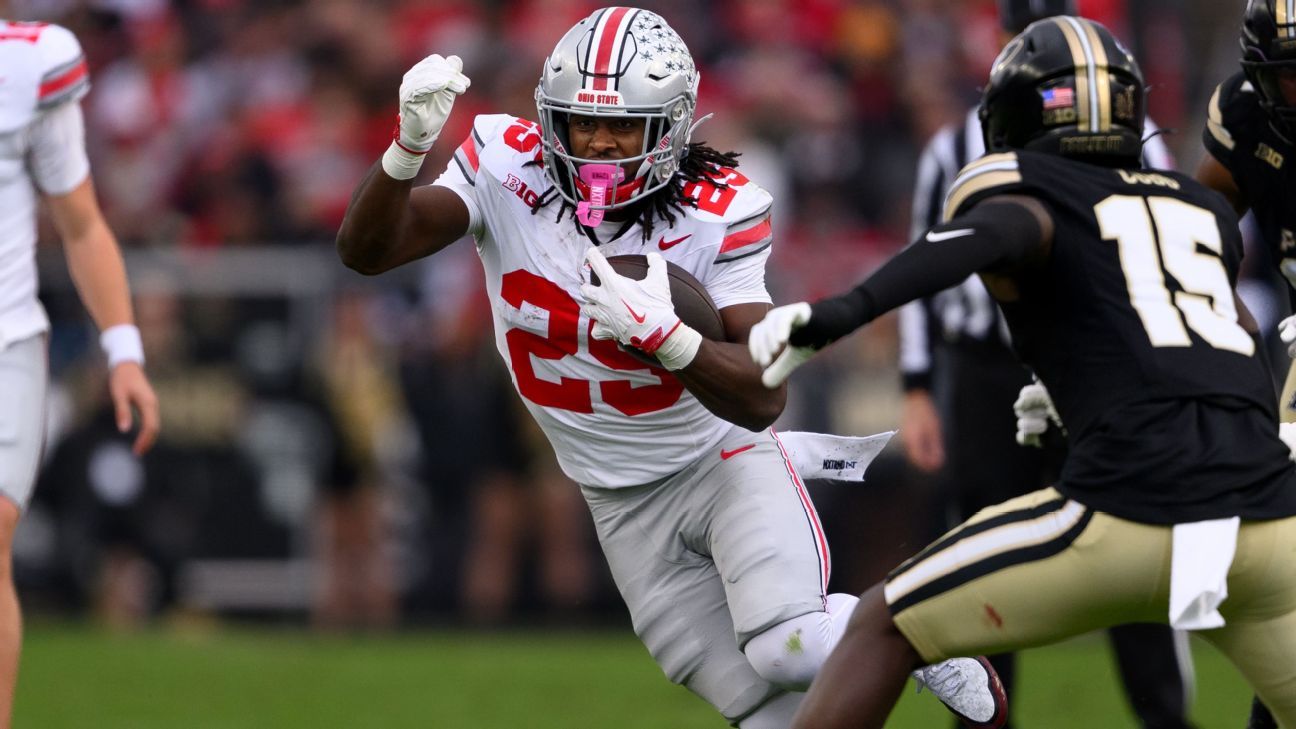
Ohio State — 99.6%: Only an adequate run game. The Buckeyes pair elite defense with a high-powered pass attack, but the ground game is useful rather than dominant. If opponents force Ohio State into pass-heavy scripts, especially in a conference title or playoff game, the offense could become too one-dimensional.
Texas A&M — 99.3%: Vulnerable inside on the ground. A&M pressures the quarterback and spaces the pass well, but it ranks near the bottom in yards per carry allowed. Powerful rushing attacks would expose that weakness in a deep postseason run.
Tier 2 (One-loss teams with clear elimination paths)
These teams are legitimate contenders but carry more obvious single-point failure modes.
Texas Tech — 90.1%: QB stability concerns. Behren Morton has produced versus a light slate but is somewhat injury-prone and middling in Total QBR. Tech can score quickly but is exposed by stout defenses and three-and-outs.
Ole Miss — 87.7%: Inconsistent ground attack. Trinidad Chambliss and Kewan Lacy have helped, yet the Rebels average only about 4.8 yards per carry and lean on the pass. A lack of a reliable rushing Plan B could doom late-game playoff efforts.
Oregon — 87.0%: Difficulty creating chunk plays against good defenses. Dante Moore flourishes against average opponents but has trouble consistently generating big passing plays when defenses tighten. Can Oregon keep finding enough offense when the deep shots are harder?
Georgia — 85.4%: Slow defensive starts. Georgia tends to dominate later in games but has lagged in first-half defensive metrics. Falling asleep for 30–45 minutes won’t work against other elite teams.
Alabama — 81.0%: Virtually no running game. Alabama’s rushing attack is anemic, placing the onus on Ty Simpson’s arm. In postseason play, predictable passing could be limiting.
Tier 3 (One- or two-loss teams with diminished CFP chances)
Still alive, but with more brittle resumes.
Notre Dame — 59.6%: Third-and-long vulnerability. The Irish frequently face long-yardage third downs on offense and allow too many long-yardage conversions on defense. Against top opponents, those long-yardage situations can be decisive.
BYU — 45.4%: Lacks consistent explosiveness against top units. Bear Bachmeier has shown promise, but BYU struggled for big plays and averaged just 4.8 yards per play in two games versus top-30 defenses.
Georgia Tech — 37.4%: Defensive frailties. The Yellow Jackets’ offense hums, but their defense ranks poorly in efficiency and explosion prevention. Recent losses exposed this and it could reappear against tougher opponents.
Tier 4a: Non-ACC teams (must run the table to solidify resumes)
These teams need perfect finishes; several measurable weaknesses make that unlikely.
Texas — 28.0%: Negative plays up front. Offensive-line breakdowns and pressure have produced lots of stuffs and negative plays. Arch Manning’s development is hampered by a shaky interior line, curbing consistency.
Oklahoma — 27.0%: Self-inflicted offensive damage. A stout defense exists, but the offense produces too many negative plays, lacks a steady big-play cadence, and turns the ball over at bad times.
Utah — 25.6%: Volatile explosiveness and turnovers. Utah looks dominant at times but can go stagnant and is turnover-prone in losses; its per-completion efficiency is modest, which could limit late-game quick points.
Vanderbilt — 25.5%: Defensive regression. Vandy’s offense can put up points and win shootouts, but coverage issues and an uptick in completion rate allowed make a long run unlikely.
USC — 15.8%: Weak run defense. The Trojans can move the ball, but their passive run defense ranks poorly in rushing success rate allowed, leaving them exposed to physical rushers.
Michigan — 7.6%: Conservative offense. Bryce Underwood’s risk-averse approach and low completion rate suppress offensive upside; Michigan stops opponents well but doesn’t create many explosive offensive plays.
Tier 4b: ACC teams (fractured title race; many carry fatal flaws)
Several ACC teams can still emerge, but each suffers a defining problem.
Miami — 15.7%: Lacking big-play juice. The offense has underperformed expectations and repeatedly failed to produce enough explosive plays late.
Virginia — 14.5%: Waning offensive energy. After a strong start the Cavaliers’ efficiency and points per drive have declined sharply; an injured Chandler Morris makes matters worse.
SMU — 11.8%: Boom-or-bust offense. Chunk plays exist, but the team’s overall success rate and three-and-out frequency are poor, making wins fragile against better defense.
Louisville — 8.1%: Too many negative snaps. A high share of plays end with zero or negative yards; injuries and line play issues amplify the problem.
Pittsburgh — 7.8%: Red zone and turnover problems. Pitt forces many three-and-outs, but gives up too many red-zone touchdowns and the offense turns the ball over at bad times.
Tier 5 (AAC and Group of Five contenders)
These Group of Five teams have steeper paths and specific weaknesses that could stop them.
James Madison — 34.3%: Turnovers and short fields. JMU defends well, but turnovers, special teams breakdowns, and short-field scores against better opponents are the biggest threats.
North Texas — 28.3%: Run defense blowups. The Mean Green can score, but their run defense has suffered massive games (306 yards allowed in their lone loss), which could derail a title chase.
South Florida — 22.4%: Softness in pass coverage. USF defends the run capably and can score, but opponents complete a high percentage of passes in USF’s losses.
Tulane — 7.5%: Defensive inconsistency. Talented and capable of marquee wins, but the defense has had ugly no-show performances that make a sustained run unlikely.
SP+ movers this week
Biggest jumps: Hawai‘i (+4.1, moved from 90th to 72nd), Utah State (+3.3), Akron (+3.1), FIU (+3.1), Kentucky (+3.1). Hawai‘i’s rout of SDSU and Kentucky’s second-half surge led the way.
Biggest drops: San Diego State (−4.5, 44th to 56th), Navy (−4.0), Florida (−3.1), Nevada (−2.8), BYU (−2.8). BYU’s Lubbock struggles — a key interception and a lost fumble — dinged its offensive SP+.
Weekly Heisman watch (F1-style points)
1) Diego Pavia, Vanderbilt — classic dual-threat OT performance. 2) Emmett Johnson, Nebraska. 3) Jake Retzlaff, Tulane. 4) Byrum Brown, USF. 5) Ashton Daniels, Auburn. 6) Bryun Parham, UConn (defense). 7) Julian Sayin, Ohio State. 8) Isaiah Smith, SMU. 9) Beau Sparks, Texas State. 10) Antwan Raymond, Rutgers.
Through 11 weeks, Julian Sayin and Ty Simpson share the points lead (29 each), followed by Taylen Green (27) and Trinidad Chambliss (25).
Top 10 games I loved this weekend
1. Indiana 27, Penn State 24 — dramatic finish and a sensational catch. 2–3. Division II thrillers: Ferris State 51, Saginaw Valley State 45 (2OT); Colorado State–Pueblo 41, Colorado Mines 34 (OT). 4. Delaware 25, Louisiana Tech 24 — late onside and a 51-yard game-winner. 5. Oregon 18, Iowa 16 — November wind and clutch kicking. 6. Vanderbilt 45, Auburn 38 (OT) — Vandy’s rally. 7–8. FCS classics: Montana 29, Eastern Washington 24; North Dakota State 15, North Dakota 10. 9. UConn 37, Duke 34 — 12 lead changes and a late turnover. 10. Sam Houston 21, Oregon State 17 — improbable comeback despite an enormous yardage deficit.
Honorable mentions included several overtime and late-drama wins across divisions and conferences.
Midweek spotlight
Tuesday’s game: Ohio at Western Michigan (8 p.m., ESPN2). The MAC title race is tightly bunched: Ohio 22.2%, Toledo 20.2%, Western Michigan 20.1%, Miami (OH) 19.2%, Buffalo 16.7% in conference title probability. The Tuesday winner should gain a big edge in the MAC chase.
Bottom line: with three Saturdays remaining before Championship Week, many teams appear locked in while others teeter on the edge. Each contender has one or two fatal flaws that, if exposed in November or December, could end playoff dreams.